How I Snuck into Giorgio Armani’s Backstage at Fashion Week

It was August 2008, and I had only been living in Milan for a month when Fashion Week took over the city. I’d managed to get freelance journalist credentials and headed out to catch some shows with my brother and his friend Cristian, who were both photographers.

On Sunday, we tried to get into Roberto Cavalli’s show, but without an invitation, security turned us away.

“How about the Giorgio Armani fashion show?” Cristian asked.

It was one of the season’s most anticipated events, taking place in the brand’s own building. I wasn’t in the mood to beg the security staff to let me in, but Cristian insisted.

“I’ll come with you—let’s see what happens.”

We arrived an hour and a half early. The street where the Armani building stood had been cordoned off by the police.

“I could tell the security guard I just arrived from Brazil and lost my invitation,” I suggested.

“No chance,” Cristian replied. “Let’s just stroll around and see what we find.”

As we approached the backstage entrance, we spotted a group of about 30 chatty girls lined up. Three security guards stood at the door while Armani staff organised the queue. Cristian nudged me and said:

“Go! Get in line.”

Without thinking, I slipped behind the guards and blended in with the girls, pretending to chat with them. The door opened, and I followed the group inside—each step bringing me closer to the Giorgio Armani universe. The girls were all holding sheets with the name and photo of a model. I had nothing but a poker face.

Inside, three staff members were handing out badges. Unsure what to do, I tried to keep a low profile and wandered around. I noticed the badges were pretty standard, and no one was asking too many questions. I chose the staff member who looked friendliest. As I approached, she accidentally dropped all the badges on the floor.

I froze. F**,* I thought. I tried not to make eye contact. Once she gathered the badges, she handed me one and apologised for the delay. It read “Vestiarista” (Stylist, in Italian). Apparently, I was now responsible for helping the models get dressed.

The backstage was buzzing—racks of clothes, photos of models on the walls, stylists everywhere. Every few minutes, security walked through to make sure everything was running smoothly. I thought of hiding in the bathroom, terrified I’d be discovered. Then I noticed a stylist looking confused, trying to figure out a vest-bikini piece. She clearly didn’t understand how it was supposed to be worn.

In a flash, I had a plan. I set my bag down to mark my spot, approached her, and spoke in a mix of Italian, Spanish and Portuguese:

“The top is inside out. This part goes on the shoulder; this is the front. Got it?”

She thanked me and asked where the toilet was. I pointed vaguely, and she walked off.

Just then, another staff member came over to explain how to put the shoes on a model. I nodded silently, pretending to understand. The stylist returned, looking slightly suspicious now.

“What exactly are you doing here?” she asked.

“I’m here to assist the security team,” I lied. “I need to make sure no one walks off with the clothes, shoes or accessories after the show. But shhh—it’s a secret.”

She was stunned by my answer and asked no further questions.

That’s when Giorgio Armani appeared.

He walked calmly through the backstage area, dressed in black trousers, a black shirt and white shoes. His white hair and blue eyes glowed. I stared at him, thinking, I need to interview him.

Soon, the models arrived. I pretended to be busy, but in reality, I had nothing to do. Everyone else was so focused on their tasks that I became invisible to them. The first show, for Armani store owners from around the world, went smoothly. The staff relaxed, and preparations began for the main show in half an hour.

I spotted a Brazilian model I knew and went over to her.

“Hi, Flavia.”

“What are you doing here?!” she asked, shocked.

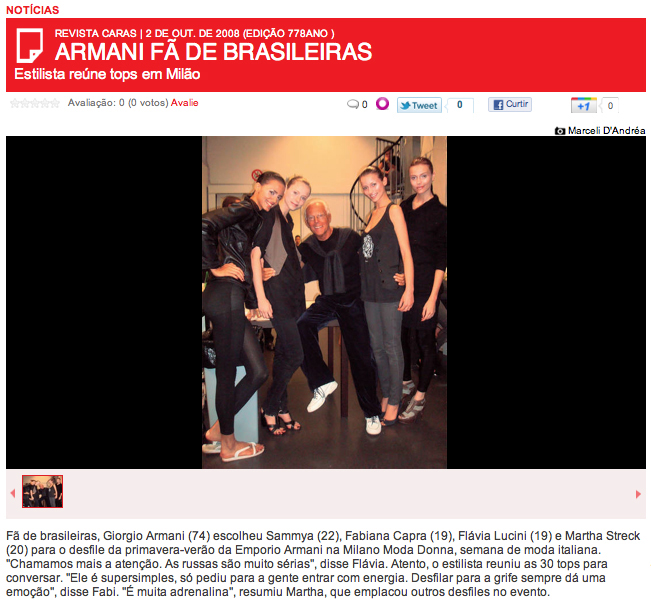
I told her everything—how I got in, how long I’d been ‘hiding’, and my idea to take a photo of the Brazilian models with Giorgio Armani to sell to a Brazilian celebrity magazine. The only problem? I didn’t have a camera.

She called over three other Brazilian models—one of them had a Cybershot camera—and they all agreed to help.

It was a hilarious scene: I, at 1.60m tall, and four statuesque models hunting down Giorgio Armani backstage.

When we saw him, I walked up and asked in my improvised dialect:

“Giorgio, posso take a photo of you with the models?”

He smiled and replied, “Certo che sì” (Of course you can).

I couldn’t believe it—I had just spoken to the Emperor of Fashion and called him Giorgio, like I was chatting with my uncle. He sat at a table, and the models arranged themselves around him. One of them, still far away, came running toward us shouting:

“Wait for meeee!”
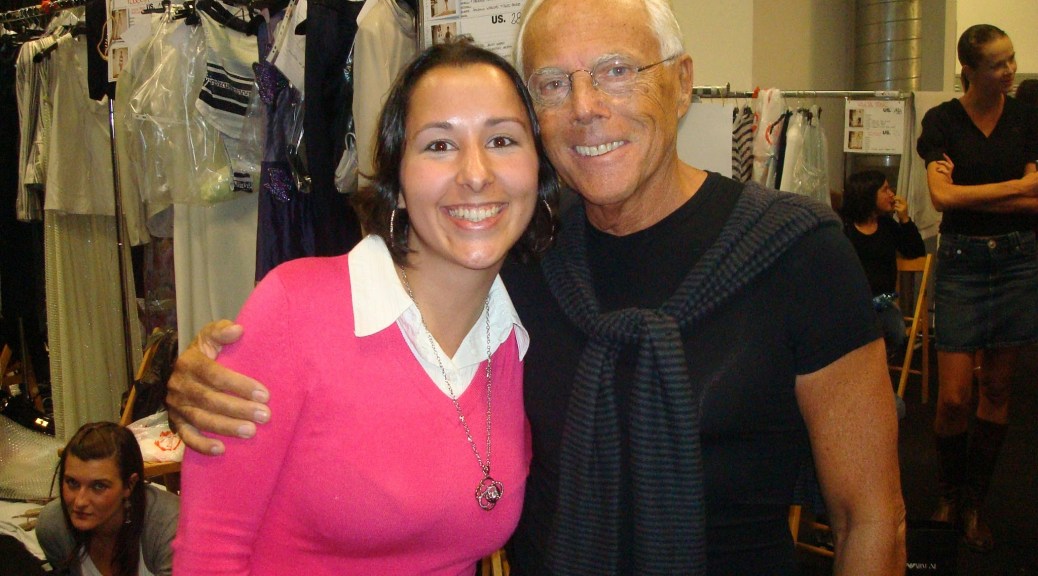
The author smiling beside Giorgio Armani backstage at Milan Fashion Week 2008. Armani is dressed in a black shirt, while the author stands beside him, beaming with excitement in a surreal, once-in-a-lifetime moment.

The photo was perfect. And since I had nothing to lose, I asked for one more favour:

“Giorgio, posso take a photo with you?”

He smiled and hugged me.
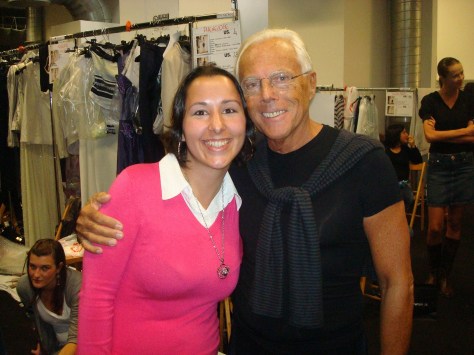
The author smiling beside Giorgio Armani backstage at Milan Fashion Week 2008. Armani is dressed in a black shirt, while the author stands beside him, beaming with excitement in a surreal, once-in-a-lifetime moment.

“Siete fantastici!” I said in Italian (You are fantastic!).

He smiled again and walked away.

When the show ended, I went home with a story to tell, a photo to sell, and an unforgettable moment etched into memory.


Overcoming Judgment: Trust Your Journey

“I was a rebel nerd. Then I became a metalhead, chains hanging from my trousers. Later, I got into electronic music. After that, I went through a spiritual phase. Now, I’m just
 me. I read some of your writing,” he said, “and I think you’re a rebel.”

That was a potential future manager’s opinion of me. I left the interview feeling crushed. Why would he say that? Sure, I question things. I have my ups and downs. But rebellion? That didn’t feel right.

Some friends told me there’s nothing wrong with being a rebel. So I searched for that rebel within me — not as something negative, but as a kind of self-therapy. And through that lens, I saw something else: authenticity.

Synonyms for authentic? Bona fide, genuine, real, true, undoubted.

Since childhood, I’ve been strong-willed and honest about my choices. The person who believes in their dreams gives them a chance to come true. And let’s be honest — it’s hard. Really hard. But I keep showing up. Every day.

That manager misjudged me — and missed the chance to know someone lighthearted, smart, and full of humour. But reflecting on that moment, I realised something deeper: you have to let go of frustration and keep going. That’s self-growth.

Bitterness won’t take you far. Judgments are shallow. When someone criticises or doubts you, it often reflects their own fear — not of who you are now, but of who you might become. They want you to stay on the same level because it’s safer that way. You can take small steps, sure. But what if I’d rather hike a mountain? Harder? Yes. But also mine.

Some people, even friends, will try to pull you back every time you do something different, bold, or simply you.

If you’ve been judged for your dreams — keep going anyway. Your path isn’t theirs. I used to let others’ doubts get in my way. But now, well into my 40s, I finally ask: Who the f*ck are they to decide what I do with my life?

So here’s my brutal advice:
Trust your gut. Follow your joy. Be your damn self.

Hello! OlĂĄ! Hola! Ciao! Salut! やあ! 안녕! 旹! đŸ€©

🌍✹ Welcome to my little corner of the world — where stories roam free and creativity has no borders.

I’m Marcelli: a writer, explorer and bon vivant.

Here, you’ll find short stories, published books, videos, pictures, and glimpses of a life lived with open arms.

No filters. No fear. Just truth, curiosity, and much love. 🌟 đŸ—ș

Stay as long as you like. 😜

Why Interaction Matters for Kids in School

Dear Parents,

I would like to inform you that your daughter, Marcelli D’Andrea, is insisting on disobeying the school’s norms and rules. Even her classmates disagree with her rebellious behaviour, indiscipline, loudness, and lack of respect towards teachers, which prevents them from giving good classes.

Today, she didn’t attend two classes and ran away to the school’s backyard. I’ve tried to talk to and advise her many times, but I’m playing a fool. To remind you, her notebook used to have pages with quotes about school and family, but she threw it away.

Due to the circumstances, she should stay at home tomorrow, April 23, 1999, to reflect on her life project.

Please, do something about it.

Best regards,
M.R.
Pedagogical Coordinator

Come on!

Rereading the note, I was amused by how personality defines our attitudes. Since I was a kid, I have had no patience to sit for hours and hours listening to someone. Today, this behaviour is often referred to as ADHD (Attention-Deficit/Hyperactivity Disorder), but since I was never diagnosed, I don’t want to make any assumptions.

What I know is that I need action and interaction. I need breaks, and I need to move. I didn’t disrespect the teachers; I lost interest after so many hours.

To say that “Even her classmates don’t agree with her rebellious attitude” makes me laugh because this still happens. Usually, when I say what I think, people remain silent, pretending that nothing is happening.

What can I do? I’m not afraid to speak up. Complaining without taking action doesn’t work.

So tell me, would you like to run away to the backyard with me? 🙂


Imagining a World Without Differences

Imagine a world where everyone was exactly the same.

We’d like the same foods and drinks. Support the same team—who would they even play against? Without disagreement, there’d be no conflict, no tension, no stories. And without different desires, we’d either want everything or nothing at all.

We’d watch the same films and eat the same popcorn—salty, please, because I’ve never liked the sweet kind. If we all chased the same dreams, we’d be journalists in London, writing about ourselves and each other. Because, after all, we’d all be the same.

We’d agree that summer is better than winter. Fashion would disappear—we’d wear the same clothes. Music would blur into one endless song, and you’d only be lucky if your favourite was also mine.

If we were all the same, your opinion would become public opinion. Your voice, my voice, our neighbour’s—indistinguishable. There’d be no secrets, no arguments, no selfishness. What’s mine would be yours. What’s yours, mine.

Prejudice, hatred, and bullying wouldn’t exist. No one would take advantage of anyone. There’d be no need for religion—we’d all believe in the same thing. And yes, we’d love one another
 because we’d be mirrors of ourselves.

We’d fall in love with the same person. Name our children the same names. Face the same problems. Live the same number of years. And, in the end, we’d die on the same day, at the same time, for the same reason.

Would the world be better that way?

Sameness breeds stagnation. It flattens the spark of life. It’s our differences—our quirks, questions, cultures, and contradictions—that make the world vibrant.

Let’s celebrate what sets us apart—it’s the very thing that makes life worth living.

Know Thyself: How to Escape the Carousel of Illusion

Throughout my life, I’ve met people who care far too much about others’ opinions. They trap themselves in fear, shut themselves off from new opportunities, and remain stuck in a dome of anxiety, addiction, stress, frustration, and depression.

Without even realising it, they become part of a carousel of illusion—spinning endlessly, afraid to step beyond the boundaries others have drawn for them.

But remember: humans are complex creatures.

Know thyself” — Socrates

For the Greek philosopher Socrates, self-knowledge is the foundation of a balanced, authentic, and fulfilling life.

So, here’s my advice: value your individuality. Learn to say “no” when someone else’s priorities don’t align with your own needs or well-being.

Staying in toxic jobs, abusive relationships, or cycles of dissatisfaction is not brave—it’s dangerous.

If I can give you some advice—well, actually seven, here they are:

  1. Strengthen your self-image — the famous: “I’m cool. 😎”
  2. Identify what really matters to you.
  3. Put yourself first.
  4. Speak your mind.
  5. Face your fears — write them down and take small steps to overcome them.
  6. Step outside your comfort zone.
  7. And finally: no matter what you do, someone will judge you. That’s their issue, not yours.

What Geniuses Teach Us About Life

“God created the world, but it should have immortalised the genius.”

That concluded a conversation with my parents about Oscar Niemeyer (1907-2012), the Brazilian architect who, while in the hospital in May 2012, expressed his desire to go home and continue working on his projects.

It’s hard not to feel proud of someone like him. Niemeyer, who lived to be 104 years old, was a renowned architect with over 80 works spread across the globe. He serves as an inspiring example to follow, and it made me wonder what the world would be like if all geniuses were immortal.

Genius: noun – a person with extraordinary intellectual and creative power. One who has such a talent or inclination: a genius at diplomacy.

I wondered what would happen if all these geniuses were gathered together for a debate. Let’s bring them all together, shall we? Among the brilliant guests, I would like to present:

The physicist Albert Einstein (1879-1955), the painter Pablo Picasso (1881-1973), the artist Michelangelo (1475-1564), the musician Mozart (1756-1791), the father of analytical psychology Carl Gustav Jung (1875-1961), the ex-football player PelĂ© (1940 – 2022), the singer Michael Jackson (1958-2009), the genius of diplomacy Mahatma Gandhi (1869-1948), the chemist Albert Hofmann (1906-2008) and the writer Gabriel Garcia Marquez (1927-2014).

After everyone was seated in their places, I started the debate.

Dear geniuses, I have a question for you, and your answer will depend on your own genius. The room was quiet, so I carried on.

I would like to know what advice you have for us humans, but not geniuses (yet).

The geniuses initially laughed at my question, but there is no such thing as a stupid question. After the laughter, Albert Einstein led the debate.

“Imagination is more important than knowledge”, the physicist said.

Pablo Picasso had a different opinion. “I am always doing that which I can not do, so that I may learn how to do it. I do not seek. I find. Art is a lie that enables us to realise the truth.”

PelĂ© agreed with him: “That is what I told Ronaldinho: Never say you are the best. Let the others say it.”

Mozart thought his answer was good but added: “Neither a lofty degree of intelligence nor imagination nor both together go to the making of genius. Love, love, love, that is the soul genius.” 

Michael Jackson agreed and said, “My advice will be, please, go for your dreams. Whatever your ideals, you can become whatever you want to become.”

Mahatma Gandhi wondered: “Joy lies in the fight, in the attempt, in the suffering involved, not in the victory itself.”

However, Michael Jackson reflected about his opinion: “Ok, but if you want to make the world a better place, take a look at yourself, and then make a change.”

Carl Jung spoke his thoughts. “Only what is really oneself has the power to heal”, and Gandhi added, “In the great battles of life, the first step to victory is the desire to win.”

Jung smoked his pipe, crossed his legs and said: “Life calls not for perfection, but for completeness.”

Michelangelo was the oldest of the group, and when the guys finally let him speak, he said: “Genius is eternal patience. I saw an angel in the marble and carved until I set him free.” 

At that moment, everyone exchanged glances. Albert Hofmann, who had remained silent until then, noticed his friends’ surprise at Michelangelo’s quote and said: “Turn on, tune in, drop out.”

The geniuses didn’t understand what Albert meant, so Gabriel Garcia Marquez decided it was better to conclude the debate: “Everything is a matter to awaken your soul. Life is a continuous succession of opportunities.” 

I was pleased with the debate, and as the brilliant minds began to leave, I lingered in thought. Suddenly, I felt a gentle hand on my shoulder. To my surprise, it was the playwright William Shakespeare (1564-1616). I had forgotten to invite him, but he had come to watch from behind the curtain. He sat next to me, and it felt as if he knew my thoughts, because he said:

“Our doubts are traitors and make us lose the good we oft might win by fearing to attempt.”

My advice to you is simple: don’t be afraid; embrace your inner genius.

Stories and snapshots for curious minds.